
Why Every Credit Union Decision Is Built on Five Layers—Whether You Realize It or Not
Walk into almost any executive planning session and you’ll hear discussions about loan growth, technology investments, branch strategy, member acquisition, or expense management. They sound like separate conversations. They usually aren’t.
The highest-performing credit unions don’t make better individual decisions. They make decisions from a consistent operating philosophy. Every major choice—from approving a merger to launching a new digital platform—flows from a hierarchy of decisions made long before the board votes.
Most organizations spend their time debating the top of the pyramid while quietly ignoring the foundation beneath it.
That’s why strategies feel disconnected. Products compete for resources. Departments optimize against different objectives. Boards approve initiatives that solve today’s problem while creating tomorrow’s.
The best leaders think differently.
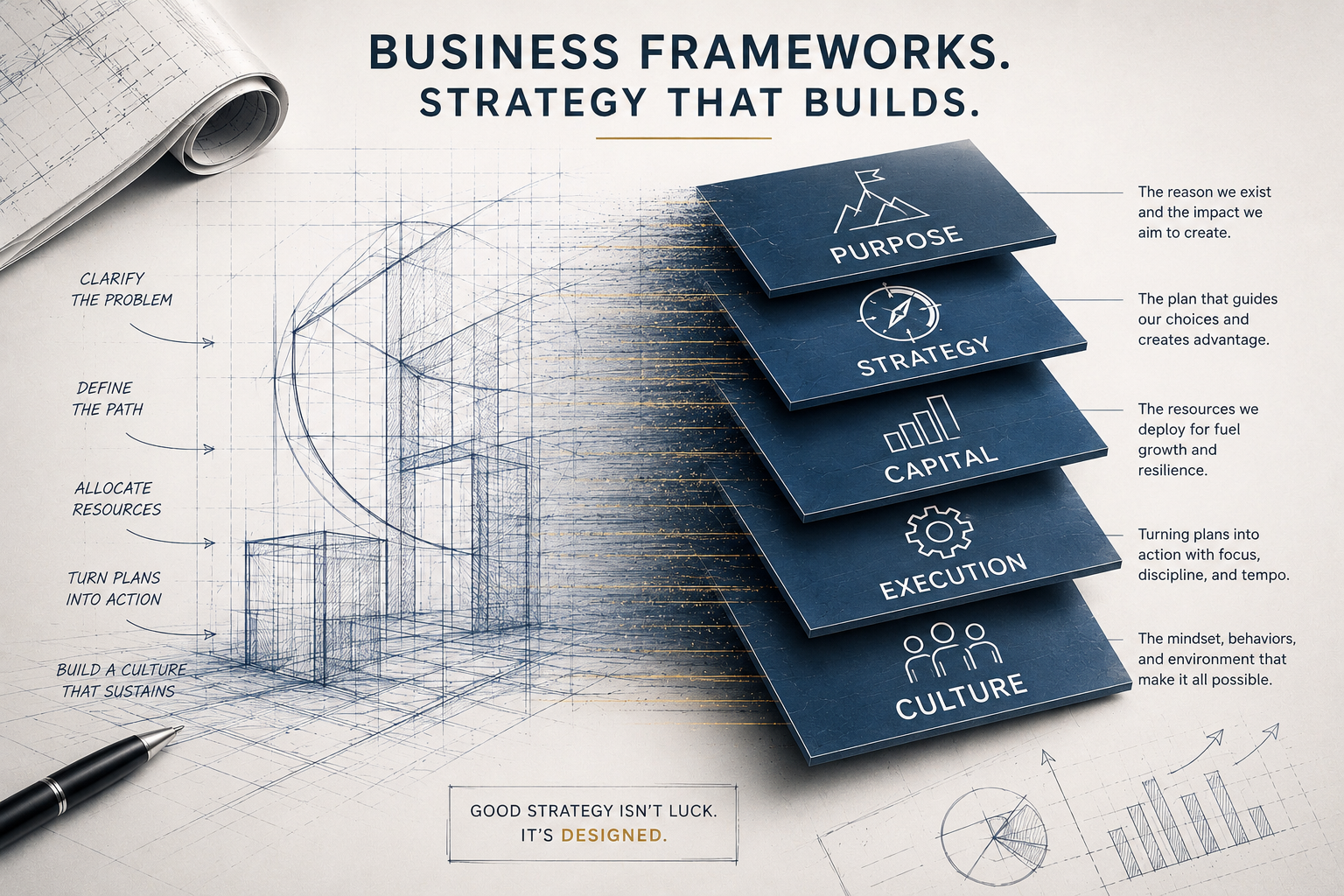
They operate from what I call The CEO Decision Stack—five layers that determine how every significant decision should be made.
Layer One: Purpose
Everything begins here.
Not with a mission statement hanging in the lobby, but with a brutally honest answer to a single question:
Why should this credit union exist ten years from now?
Purpose is the operating system beneath every strategy.
If a credit union exists primarily to maximize efficiency, its decisions will naturally look different than one that exists to maximize financial inclusion. If leadership believes its role is to become the dominant regional financial institution, it will allocate capital differently than one determined to remain the most trusted community partner.
Purpose eliminates thousands of future debates because it establishes the lens through which every opportunity is evaluated.
Without clarity here, every strategic discussion becomes an argument about preferences.
Layer Two: Strategy
Once purpose is defined, strategy answers the next question:
Where will we win—and just as importantly, where won’t we?
Many organizations mistake ambition for strategy.
“We want to grow.”
“We want younger members.”
“We want to be digital-first.”
Those are aspirations.
Strategy requires tradeoffs.
Will growth come organically or through mergers? Will the organization compete on member experience or operational efficiency? Will technology be built internally or acquired through partnerships? Will the institution deepen existing relationships or expand into entirely new markets?
Great strategy is as much about saying no as it is about saying yes.
Every resource committed to one priority is unavailable for another.
Layer Three: Capital
Capital is more than dollars on a balance sheet.
It’s every scarce resource the organization controls.
Financial capital.
Leadership attention.
Technology investment.
Talent.
Time.
The question is deceptively simple:
Where should our next dollar create the greatest long-term advantage?
Too often, budgeting becomes an exercise in preserving the past rather than funding the future.
Exceptional CEOs understand that capital allocation is strategy in action. It reveals what leadership truly believes, regardless of what appears in the strategic plan.
Organizations don’t become what they aspire to be.
They become what they consistently invest in.
Layer Four: Execution
Even brilliant strategy fails without disciplined execution.
Execution isn’t about working harder. It’s about building systems that consistently translate decisions into results.
Operating cadence.
Decision rights.
Performance measurement.
Cross-functional accountability.
Meeting rhythms.
Governance structures.
These rarely generate headlines, yet they often determine whether a strategy succeeds or quietly disappears beneath the weight of organizational complexity.
Execution is where vision either compounds—or evaporates.
Layer Five: Culture
Culture sits at the top of the stack because it is the expression of everything beneath it.
Purpose shapes strategy.
Strategy guides investment.
Investment enables execution.
Execution ultimately creates culture.
Culture is simply how people make decisions when leadership isn’t in the room.
It determines whether employees solve problems or wait for permission. Whether innovation is encouraged or quietly avoided. Whether members experience consistency across every interaction or encounter a different institution every time they engage.
The strongest cultures are rarely created through slogans.
They emerge from thousands of decisions made consistently over many years.
Why the Stack Matters
Every major challenge facing credit unions—artificial intelligence, mergers, fintech partnerships, cybersecurity, talent shortages, branch transformation, demographic shifts—can be traced back through these five layers.
Should we merge?
That’s a strategy question grounded in purpose.
Should we build an AI capability?
That’s a capital allocation decision informed by strategy.
Should we close branches?
That’s an execution decision influenced by culture.
Leaders often debate the symptom while ignoring the layer where the real decision belongs.
The CEO Decision Stack provides a common language for boards and executive teams to identify where a decision actually lives before deciding what to do about it.
Boardroom Questions
Is our purpose specific enough to eliminate opportunities that don’t fit?
Have we clearly defined where we will compete—and where we won’t?
Does our capital allocation reflect our stated strategy or our historical habits?
Are our operating systems capable of executing the future we describe?
Would our culture produce the same decisions if the executive team disappeared for a month?
Executive Takeaway
Leadership isn’t the accumulation of hundreds of disconnected decisions.
It’s the discipline of making every decision from the same foundation.
Credit unions don’t become strategically aligned by accident. They become aligned when purpose, strategy, capital, execution, and culture reinforce one another instead of competing for attention.
Every organization has a decision stack.
The only question is whether it was designed intentionally—or assembled by default.
Leave a Reply