
Why Credit Union Growth Begins With Trust—and Accelerates Through Reinvestment
Most credit unions still describe growth as a collection of outcomes.
More members.
More deposits.
More loans.
More assets.
Those metrics matter, but they do not explain why some institutions compound for decades while others grow in short bursts, stall, and return to the strategic planning table looking for another campaign.
Sustainable growth is not linear. It is systemic.
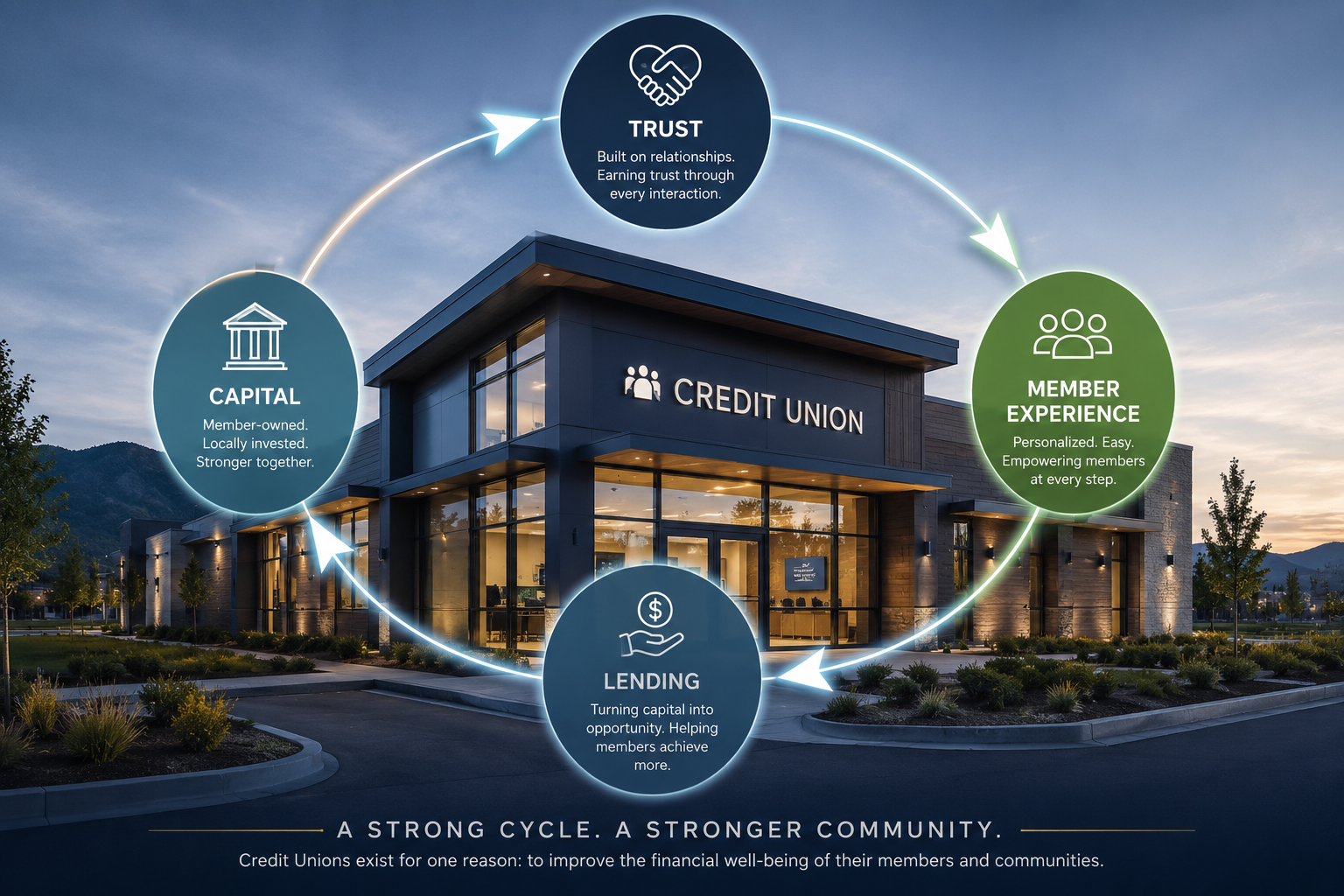
The strongest credit unions do not simply acquire members, gather deposits, make loans, and report earnings. They build a reinforcing loop in which each advantage strengthens the next. Trust attracts members. Members provide deposits. Deposits fund lending. Lending generates earnings. Earnings fund better capabilities. Better capabilities improve the member experience. A better experience creates more trust.
The cycle repeats.
This is The Cooperative Flywheel.
Its central idea is simple:
Banks compound capital. Credit unions compound trust.
That distinction is not sentimental. It is economic.
Trust lowers acquisition costs, increases retention, deepens relationships, improves product adoption, and gives members a reason to choose the institution again when the next financial need appears. When that trust is converted into deposits, lending, earnings, and reinvestment, cooperative purpose becomes more than a value statement.
It becomes a growth engine.
The Problem With Linear Growth
The traditional growth model looks like a straight line.
Launch a campaign. Add members. Generate applications. Book loans. Repeat next quarter.
That approach can produce volume, but it often creates activity without momentum. Each new campaign starts from zero. Each department optimizes its own metric. Marketing celebrates account openings while lending struggles to convert them. Technology launches tools that members barely use. Finance protects earnings by delaying the investments that might improve future performance.
The organization grows, but the system does not get stronger.
This is the difference between adding and compounding.
Linear growth depends on continuous effort. The moment spending slows, volume slows with it.
A flywheel works differently. Early movement requires significant force, but every successful turn makes the next turn easier. Growth begins to reinforce itself because the institution is not merely generating transactions. It is strengthening the conditions that create future transactions.
For credit unions, the first condition is trust.
Stage One: Member Trust
The flywheel begins before the account is opened.
It begins with a belief that the credit union will act in the member’s interest.
That trust may come from a family relationship, an employer connection, a community reputation, a competitive rate, a helpful employee, or the institution’s response during a difficult financial moment. Whatever its origin, trust reduces the perceived risk of choosing the credit union.
This matters because financial relationships are built on uncertainty. Members cannot fully evaluate underwriting quality, cybersecurity controls, liquidity management, data governance, or long-term institutional stability. They make decisions using signals.
Reputation is one signal.
Service is another.
Consistency may be the most important of all.
A credit union strengthens trust when its pricing matches its promises, its technology works when needed, its employees solve problems without unnecessary friction, and its leadership demonstrates that cooperative values affect actual decisions.
Trust is weakened when the institution says “member first” but designs every process around internal convenience.
The flywheel cannot outrun that contradiction.
Stage Two: Member Growth
Trust becomes economically valuable when it attracts and retains members.
The strongest member growth is not simply the result of broader marketing reach. It comes from credibility moving through networks: families, employers, neighborhoods, professional communities, social circles, and digital recommendations.
That is why referral-driven growth is so powerful. A recommendation transfers a portion of one member’s trust to another before the new relationship begins.
But membership totals can be deceptive.
A new account is not necessarily a new relationship. Credit unions often celebrate membership growth while adding low-engagement accounts that produce little deposit activity, borrowing demand, or long-term loyalty.
The flywheel requires more than acquisition. It requires meaningful participation.
The question is not simply, “How many members did we add?”
It is, “How many people now see us as relevant to their financial lives?”
That is a harder standard—and a more useful one.
Stage Three: Deposits
Member relationships create funding.
Deposits are often treated as a pricing problem: raise rates, launch a certificate special, and attract balances. But the most durable deposits are rooted in behavior rather than promotion.
Payroll deposits.
Operating accounts.
Emergency savings.
Household cash management.
Business relationships.
These balances are valuable because they reflect relevance. The credit union is not merely holding money; it has become part of the member’s financial operating system.
This is why deposit strategy cannot be separated from member experience. A competitive yield may attract money temporarily, but convenience, trust, payments functionality, and service determine whether the relationship remains when the promotional period ends.
Deposits are the fuel of the cooperative model.
Yet funding alone does not create impact. Deposits sitting idle may protect liquidity, but they do not complete the promise of financial intermediation.
The flywheel moves when those deposits are put to work.
Stage Four: Lending
Lending is where the cooperative model becomes tangible.
Member deposits finance homes, vehicles, businesses, education, emergencies, and major life transitions. This is the point at which pooled capital returns to the community in the form of opportunity.
Strong lending creates value in two directions.
The borrower gains access to capital.
The institution creates earning assets that support financial performance.
But volume alone is not the objective. Poorly priced or poorly underwritten growth can create the illusion of momentum while weakening the institution beneath the surface.
The flywheel depends on disciplined lending: products members need, delivered at the right price, through a process fast enough to compete and prudent enough to endure.
A credit union that cannot convert funding into responsible loan growth will eventually face margin pressure, excess liquidity, or the temptation to stretch beyond its risk capacity.
A credit union that deploys deposits intelligently turns trust into economic productivity.
Stage Five: Financial Performance
Mission and financial performance are often discussed as though they exist in tension.
They should not.
Financial strength is what allows the mission to survive changing rates, recessions, credit cycles, technology shifts, regulatory pressure, and leadership transitions.
Healthy earnings build capital.
Capital creates flexibility.
Flexibility gives leadership the ability to invest before a crisis forces the decision.
The critical distinction is what the institution does with that performance.
If earnings become an endpoint, the cooperative flywheel slows. The organization may remain safe, but safety gradually becomes stagnation.
If earnings are treated as renewable strategic capacity, performance becomes the bridge between today’s success and tomorrow’s relevance.
The purpose of strong economics is not to imitate shareholder returns.
It is to preserve the ability to serve.
Stage Six: Reinvestment
Reinvestment is where strategy becomes visible.
Every credit union claims to value its members. The budget reveals how much it values their future experience.
Reinvestment may take the form of stronger digital infrastructure, better cybersecurity, faster origination, improved data capabilities, leadership development, branch redesign, new products, community partnerships, or more competitive pricing.
The specific investment matters less than the strategic logic connecting it to the flywheel.
Does the investment reduce friction?
Does it improve trust?
Does it deepen relationships?
Does it expand lending capacity?
Does it strengthen resilience?
A credit union can spend heavily without reinvesting intelligently. Technology projects become expensive ornaments. Branch renovations improve aesthetics without changing member behavior. Innovation teams produce pilots that never reach scale.
Reinvestment should not be measured by how much was spent.
It should be measured by how much stronger the system became.
Stage Seven: Member Experience
Reinvestment returns to the member through experience.
This is where strategy is either validated or exposed.
Members do not experience capital ratios, project plans, governance structures, or vendor roadmaps. They experience whether the app works, whether a loan decision arrives quickly, whether an employee can resolve a problem, whether pricing feels fair, and whether the institution recognizes the full relationship.
The member experience is not a department.
It is the accumulated result of decisions made across the entire organization.
A slow mortgage process may appear to be an operations problem, but its roots could sit in outdated technology, unclear decision rights, weak vendor integration, or underinvestment in talent.
A frustrating digital experience may look like a technology problem, but it may actually reflect a strategy that never clarified which member journeys mattered most.
The flywheel forces leaders to see experience as an output of the operating system, not a layer of polish placed on top.
When the experience improves, trust deepens.
The wheel completes another turn.
Trust Compounds
The Cooperative Flywheel is not a sequence the institution completes once.
It is a continuous system.
Trust produces growth.
Growth creates funding.
Funding supports lending.
Lending generates performance.
Performance enables reinvestment.
Reinvestment improves experience.
Experience creates more trust.
Each successful turn increases the institution’s capacity to complete the next.
This is why two credit unions with similar assets, capital, and markets can produce radically different long-term outcomes. One operates as a collection of functions. The other operates as a reinforcing system.
The first asks each department to hit its targets.
The second asks each decision to strengthen the flywheel.
The Flywheel Accelerators
Not every capability belongs inside the wheel.
Some increase its speed.
Technology is an accelerator because it can reduce friction, expand access, lower unit costs, and improve personalization. But technology without strategic clarity can just as easily introduce complexity.
Data is an accelerator because it helps leaders understand member behavior, anticipate needs, improve underwriting, and allocate resources more intelligently. But data without governance creates noise and risk.
Talent is an accelerator because better people make better decisions and execute with greater consistency. But talent without clear priorities becomes expensive motion.
Brand is an accelerator because it compresses the time required to establish trust. But brand without operational credibility creates promises the institution cannot keep.
Governance is an accelerator because strong decision rights, accountability, and board alignment help the organization act with discipline. But governance that confuses oversight with hesitation slows every turn.
Community is an accelerator because local credibility, partnerships, and visible impact deepen the institution’s relevance. But community activity disconnected from strategy can become philanthropy without institutional momentum.
The accelerators do not replace the flywheel.
They increase its velocity.
Where the Flywheel Breaks
Most stalled credit unions do not lack effort. They have a break somewhere in the loop.
Some have trust but fail to convert it into deeper relationships.
Some attract members but do not become their primary financial institution.
Some gather deposits but cannot generate enough loan demand.
Some grow loans but price risk poorly.
Some produce strong earnings but underinvest in future capabilities.
Some invest heavily but fail to improve the experience members actually feel.
The framework helps executives locate the constraint.
If deposits are growing while loans are not, the problem may not be funding. It may be product relevance, origination speed, market positioning, or risk appetite.
If membership is increasing but deposits remain flat, acquisition may be generating accounts rather than relationships.
If technology spending is rising but trust is falling, reinvestment is not reaching the member experience.
The wheel is only as strong as its weakest connection.
Growth strategy should begin by identifying where momentum is being lost.
Applying the Flywheel to Strategic Decisions
The framework changes how leaders evaluate investments.
Consider a new digital lending platform.
The traditional business case may focus on cost, conversion, and implementation time. The flywheel adds a broader test.
Will the platform make borrowing easier?
Will faster decisions improve the member experience?
Will a better experience increase trust and future product adoption?
Will stronger loan growth improve financial performance?
Will the resulting earnings create additional reinvestment capacity?
A strong investment does not merely solve one problem.
It strengthens several stages of the system.
The same test can be applied to branch decisions, fintech partnerships, mergers, marketing campaigns, talent investments, data initiatives, and pricing changes.
The question is not only, “Will this initiative produce a return?”
It is, “Which parts of the flywheel will this strengthen—and what could it weaken?”
Boardroom Questions
Where does our flywheel currently lose the most momentum?
Are we acquiring members or building meaningful financial relationships?
Do our deposit strategies create durable funding or temporary rate-driven balances?
Are we deploying member deposits effectively without outrunning our risk capacity?
Does our financial performance create strategic flexibility, or are we protecting earnings at the expense of future relevance?
Can we clearly connect our largest investments to an improved member experience?
Which accelerators—technology, data, talent, brand, governance, or community—would most increase the speed of our flywheel?
What evidence shows that member trust is actually increasing?
Executive Takeaway
The strongest credit unions do not grow through isolated initiatives.
They grow by building a system in which every advantage reinforces the next.
Trust is not the soft side of the cooperative model. It is the beginning of the economic model. When trust attracts members, members provide funding, funding supports lending, lending creates earnings, and earnings improve the experience, cooperative purpose becomes self-reinforcing.
That is the real strategic advantage of member ownership.
But the flywheel does not turn because the model exists on paper. It turns because leadership deliberately connects mission, economics, investment, and experience.
Every credit union has the pieces.
The winners will be the ones that make them compound.
Leave a Reply